
-
Developers complain about walls of AI-written text but rarely about walls of code. That asymmetry says something about the mindset the industry is biased toward, how code-plus-English became a gate, and whether language models will lower it or build a new one.
-

A poem and photos from an autumn afternoon in Vancouver’s Chinatown.
-

A reference list has always had two audiences: scholars and serious readers who want to follow a claim back to its sources, and the librarians, indexers, and catalogue-keepers who keep track of what has been written. Until recently both were human.
-
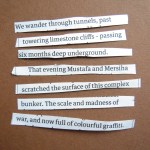
Trying WordPress’s Lineate and Redact blocks for shaped verse, unusual spacing, and blackout poetry—with examples ranging from Ezra Pound to an erasure poem made from a Portland weather report.
-

Ivan Illich’s thinking interacted deeply with Paul Celan’s poetry and his extraordinary use of the German language. Celan called it his Muttersprache and Mördersprache. Illich said of himself, he grew up with five languages and no mother tongue.
-

Tables of contents, indexes, glosses, footnotes, and even the size of a book emerged and evolved as the codex’s interface: tools for finding, checking, and arguing over ideas and their sources. This is a history of the book’s apparatus, its paratexts, and the page as an interface — one the web permits but rarely supplies.
-

A poem written to answer half of a question, “What are the essential conditions that make community possible, whose absence or removal makes community impossible?” The answers come from medieval monastic sources, as recovered and elaborated by Ivan Illich.
-

Only when a person will not do some things are they capable of doing great things.
-

Gerald Weinberg’s paradoxes of software systems, a Vermeer with a bare wall behind it, and Tomas Tranströmer revising his way toward an ending. What joins them is the work intentionally withdrawn or left undone, and the space that decision opens.
-

“Three ships hove to, three whales flayed on ice.” A poem about a painting of the early modern Dutch Arctic fishery in the Svalbard archipelago, by Abraham Storck (1654–1708). Three mountain peaks there are named for the Norse Fates — the Norns who determine the past, present, and future.